
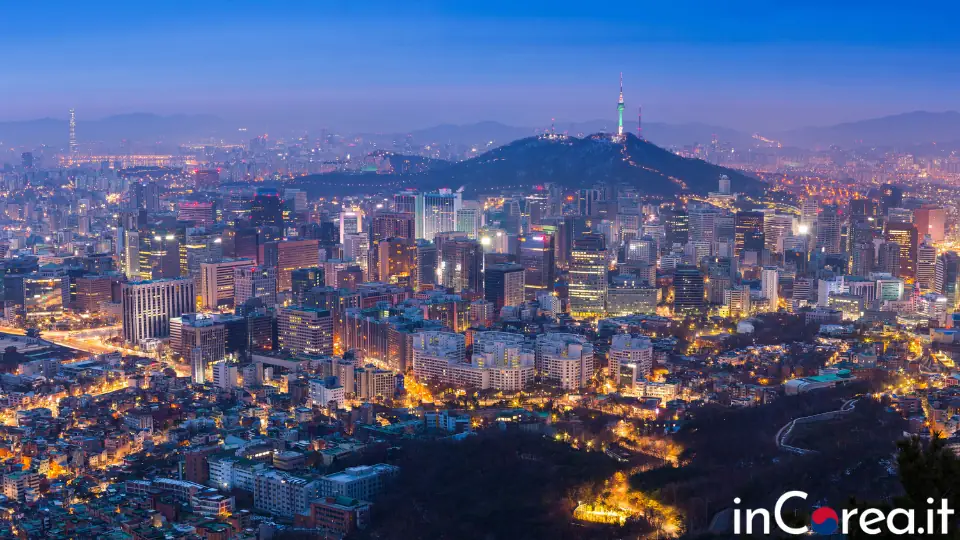
Having a good itinerary for Seoul is the first step to fully enjoy South Korea’s capital, especially if it’s your first visit. My first piece of advice is to dedicate at least 3–4 days to the city. While this may seem like just a short amount of time, it’s enough to explore the most famous sites and start to truly understand the essence of Seoul.
Because of its variety, visiting Seoul feels like exploring many different cities at once. Modernity and tradition coexist side by side, creating fascinating contrasts throughout the city.
On my first trip to Korea, I spent ten days in Seoul, and even then, I felt there was never enough time. In this article, I’ll share the best itinerary for visiting Seoul from three to seven days, so you can decide exactly what to do and what to see depending on the length of your stay. This guide is especially useful for those visiting Seoul for the first time, but it can also inspire returning travelers who want to discover new attractions.
A final tip: this is only a suggested itinerary, which I built by grouping attractions located close to each other to make getting around easier. Feel free to adjust it to your preferences, needs, or timing. You can swap out or skip places as you wish. At the end of the article, I’ve also included ideas for areas in Seoul and neighboring cities that you may want to add to your plan.
Choosing the right neighborhood for your hotel in Seoul is essential to make your trip smoother and more comfortable. So, what are the most central neighborhoods to stay in Seoul? Definitely Myeongdong and Insadong, thanks to their proximity to the city’s main attractions. These areas are also lively in the evenings, filled with restaurants and cafes, making them perfect if you prefer not to travel far at night but still want to enjoy the city atmosphere.
Another neighborhood I personally love is Hongdae. With its vibrant energy, countless restaurants, trendy cafes, and street performers, it’s one of the most enjoyable areas to stay in. While it’s slightly less central, it’s still well connected and not too far from the main attractions.
Below, you’ll find a selection of recommended hotels located near subway stations in different neighborhoods:
To learn more about where to stay in Seoul and how to choose the right neighborhood, check out the full article on where to stay in Seoul.
In almost every itinerary, Seoul is the first destination, since most international flights to Korea land at Incheon International Airport, located not far from the city. Unless your flight arrives very early in the morning, it’s best to take it easy on your arrival day. Explore the neighborhood around your hotel, enjoy your first Korean dinner, and get some rest to start adjusting to the new time zone. One important tip: if you arrive during the day, avoid going straight to sleep at your hotel, as this will only make your jet lag worse. Instead, go about your day normally and head to bed at night — this way, your body will adapt much faster.
The itinerary we suggest is designed especially for first-time visitors to Seoul. It allows you to explore the city at a comfortable pace, with destinations grouped together to make getting around as easy as possible.
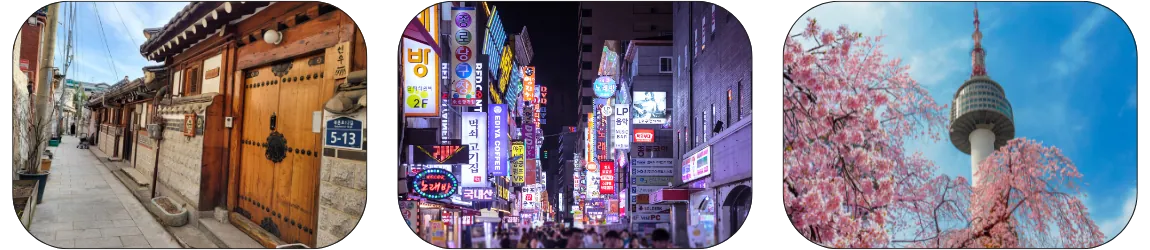
On your first day, focus on the northern part of Seoul, particularly the district of Jongno. This neighborhood is one of the city’s most historically rich areas, having served as the cultural and political heart of Seoul for more than 600 years.
Bukchon Hanok Village
If you are staying in Insadong or nearby, you won’t even need public transportation to reach the Bukchon Hanok Village, a traditional neighborhood dating back about 600 years. If you’re coming from elsewhere, simply get off at Anguk Station on Metro Line 3. Here, time seems to stand still, offering a glimpse of life in 15th-century Korea. The village is famous for its Hanok houses, traditional Korean mansions once inhabited by nobility and aristocrats.
Some experiences to enjoy at Bukchon Hanok Village:
Myeongdong
From Anguk Station, take Line 3 to Chungmuro Station, then transfer to Line 4 and get off at Myeongdong Station. And here you are in Myeongdong, the ultimate paradise for street food, budget shopping, and Korean cosmetics!
Since I also recommend coming back here in the evening, you don’t need to explore every corner right away. If it’s raining or if you’d like to start discovering Seoul’s amazing shopping malls, head to the massive Lotte Department Store, which also features excellent restaurants inside (Korean mall food courts are famous for their variety and quality). On the official Lotte Department Store website you can find a convenient floor map with all the shops and restaurants. Don’t miss the three floors of Lotte Duty Free, where you can buy electronics, cosmetics, and more at great prices.
Seoul Namsan Tower
Reaching the Seoul Tower from Myeongdong is very easy, as Myeongdong Station is the closest subway stop. You can get there on foot, by bus, or by cable car. Full details on each option are explained in our dedicated article on Seoul Tower, where you can also find discounted tickets for the Namsan Tower Observatory and for the cable car.
Once at the top of Namsan Mountain, beyond enjoying a spectacular sunset over Seoul, there are plenty of things to do:
For a full list of attractions and restaurants, visit the official N Seoul Tower website.
At the end of this first full day, you can either dine at one of the restaurants inside the tower or, if it’s not too late, head back down to Myeongdong. There, you’ll find countless restaurants and an endless choice of street food stalls to wrap up the evening in true Seoul style.
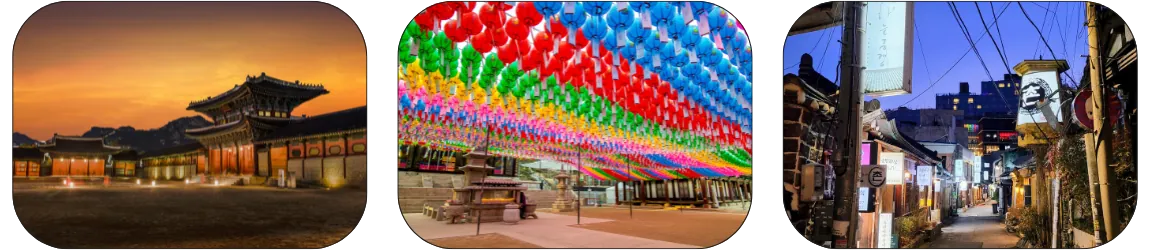
On the second day, the itinerary moves into the city center. All of today’s destinations are within walking distance, allowing you to experience both Seoul’s wide boulevards and its charming narrow streets. You can change the order of the attractions if you wish, but we recommend ending the day with dinner in Insadong — the atmosphere in its alleys and restaurants is an experience not to be missed.
Gyeongbokgung Palace and Gwanghwamun Square
The Gyeongbokgung Palace is a must-see, no matter how long you’re staying in Seoul. It is the largest and most important imperial palace in South Korea. To get there, take Subway Line 3 to Gyeongbokgung Station. To also visit Gwanghwamun Square, you’ll need Line 5 and get off at Gwanghwamun Station — but I highly recommend coming back in the evening, when the square is especially beautiful. After exploring the palace grounds, don’t miss the National Folk Museum, free to enter, where you can walk through Korea’s history from ancient times to the present. Please note: Gyeongbokgung Palace is closed on Tuesdays. Full details about tickets and guided tours can be found in the link above.
Ikseondong Hanok Village
Logistically, Ikseondong comes before Jogyesa, but for the best flow, we suggest visiting it after Gyeongbokgung and heading there for lunch. Unlike Bukchon Hanok Village, Ikseondong Hanok Village has undergone a major transformation: the old hanok houses have been converted into stylish cafes and restaurants. It’s the perfect spot to stop for lunch, with countless options available. If you have a sweet tooth, I recommend trying the soufflé pancakes at DongBaek Bakery, a charming café inside a hanok decorated with vintage European furniture. Afterward, take your time exploring the area’s picturesque cobblestone alleys.
Jogyesa Temple
A 15-minute walk from Ikseondong brings you to Jogyesa Temple, nestled among skyscrapers and modern buildings. This peaceful temple is a cornerstone of Korean Buddhist history, and if you’re lucky, you may witness a Buddhist ritual or hear the 33 chimes of the 6 p.m. bell. Take your time here: close your eyes, listen, and let yourself be transported to another era.
Insadong
Just five minutes from Jogyesa Temple lies the wonderful district of Insadong. If you decide to stay in Insadong, you’ll have the chance to return to your hotel before spending the evening wandering its alleys. Insadong is one of Seoul’s most famous areas for art galleries, antique shops, tea houses, and calligraphy stores. It’s also the best place in the city to buy souvenirs and gifts. Be sure to visit Ssamziegil, a unique complex filled with local craft and art shops. As the sun sets, pick a traditional restaurant tucked away in the neighborhood’s alleys — you’ll be spoiled for choice.
To end the day, if you still have time and energy, consider taking an evening stroll along the beautiful Cheonggyecheon Stream.
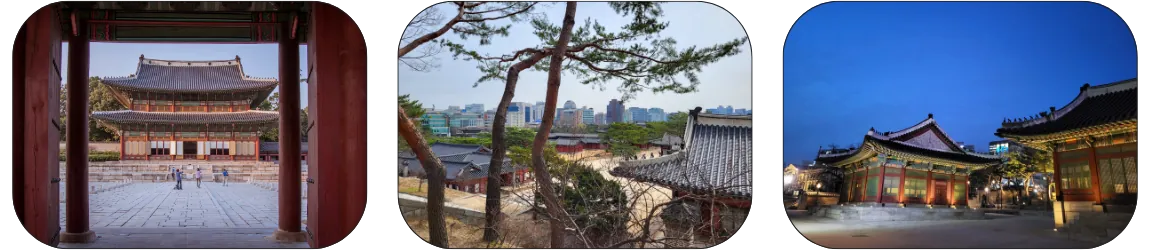
On the third day of our Seoul itinerary, we continue exploring the city’s rich history. For those who unfortunately have only three days in Seoul, I’ve included a few alternative suggestions for the afternoon and evening.
Changdeokgung and Changgyeonggung Palace
The Changdeokgung Palace is another stunning royal residence from the Joseon era. The nearest subway stations are Anguk (Line 3) or Jongno 3-ga (Lines 1 and 5), though the latter is a bit farther away. Highlights include the Western-style greenhouse built in 1909 and the beautiful Huwon Secret Garden, which was once reserved for the royal family and is now open to the public via guided group tours (tickets available on-site). Continuing your visit, you’ll also reach the Changgyeonggung Palace, which feels almost like an extension of Changdeokgung.
Jongmyo Shrine
Within walking distance lies Jongmyo Shrine, the oldest Confucian shrine in the world still in use. Built around the same time as Gyeongbokgung Palace, it has long hosted the Jongmyo Jaerye, a major royal ancestral rite. Today, the reenactment of this historic ceremony takes place every year on the first Sunday in May. Its musical component, Jongmyo Jaeryeak, combines instruments, songs, and dances that date back more than 500 years.
Deoksugung Palace
If you still have energy, head to the Deoksugung Palace via Subway Line 1 to City Hall Station. Unlike other palaces, Deoksugung is known for its blend of traditional 15th-century Korean design and early 20th-century Western architecture. Visiting just after sunset makes the experience even more atmospheric.
If your trip to Seoul is only three days, you may want to skip Jongmyo Shrine and Deoksugung, and instead allocate your limited time to other areas. If you choose to stay close to Changdeokgung and Changgyeonggung (which are must-see stops), here are some nearby alternatives worth visiting within a few subway stops: Dongdaemun Design Plaza, Gwangjang Market, Ihwa Mural Village, or a walk along Cheonggyecheon Stream leading to Gwanghwamun Square.
For those with more time, here are additional alternatives located farther away:
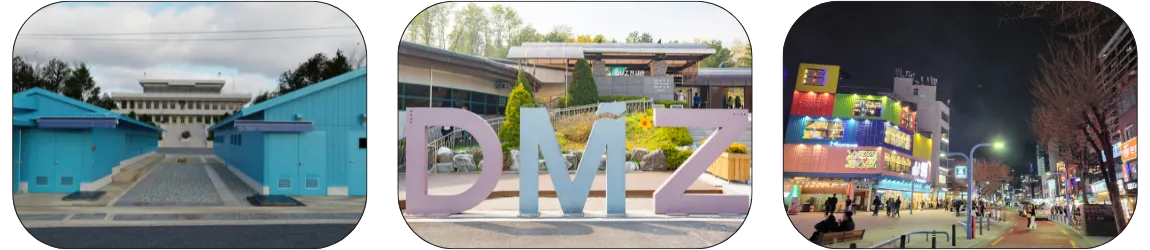
DMZ – Korean Demilitarized Zone
What many don’t realize is that Seoul lies very close to the border with North Korea. The DMZ is a buffer zone about 4 km wide and 250 km long, separating the two Koreas. It can only be visited through an organized tour with authorized guides. We strongly recommend that you purchase your guided DMZ tour in advance, as the number of daily visitors is strictly limited. There are two main options — a shorter tour and a more comprehensive one — both available through the link above.
Hongdae
When you return from the DMZ, you’ll still have part of the afternoon and evening free. We recommend heading to Hongdae, Seoul’s vibrant university district, or alternatively staying in Myeongdong. Depending on the guided tour, drop-off will usually be at Myeongdong or City Hall Station. From either station, you can take Metro Line 2 to Hongik University Station.
Once there, head to Yanghwa-ro, one of the main streets in the district, filled with shops — including a massive Samsung store and the Kakao Friends Hongdae Flagship Store, where you can find every gadget related to Korea’s most popular messaging app.
Then explore lively Hongdae Street, where street performers and aspiring K-pop artists entertain the crowds. For dinner, choose from the countless restaurants in the area. Prices are affordable, and the quality is excellent.
As an alternative, you could also stay closer to your hotel: enjoy dinner in Myeongdong and then take a pleasant evening walk along the Cheonggyecheon Stream.
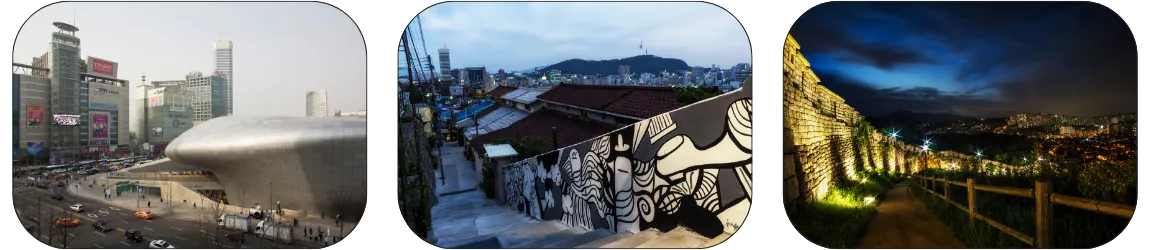
Dongdaemun – DDP
Start your day at the Dongdaemun Design Plaza (DDP), which you can reach via Subway Lines 2, 4, or 5. This futuristic landmark is famous for its massive architectural structure designed by Zaha Hadid, which houses exhibition halls, the DDP Museum, large pedestrian areas, and installations such as its 25,550 LED-illuminated artificial roses.
In addition to DDP, the Dongdaemun area is home to one of Seoul’s most important markets: the Dongdaemun Market, best known for textiles and tailoring. Not far away, you’ll find the bustling Gwangjang Market, where countless street food stalls serve Korean favorites at affordable prices.
Ihwa Mural Village
From Dongdaemun, begin your walk toward the Heunginjimun Gate (also called Dongdaemun Gate), one of the eight historic gates in Seoul’s old city walls. Right after passing through the gate, you’ll start following the ancient walls as they climb up Naksan Hill. At the end of the walk, you’ll arrive at Ihwa Mural Village.
If you’d like a shorter walk, you can instead take the subway to Hyehwa Station (Line 4), but you’ll miss out on the beautiful scenic walk along the ancient walls of Seoul. Ihwa Mural Village was revitalized in 2006 as part of the “Ihwa-dong Naksan Project,” with murals and installations created by around 70 artists. Keep in mind this is a residential neighborhood, so please visit quietly and respectfully.
Naksan Park
For those who want to keep exploring, head a bit further into Naksan Park. The park and mountain take their name from their resemblance to a camel’s back. Located on a hill, the park is most famous for its stunning sunset and night views of Seoul. It has also served as a filming location for popular K-dramas such as The Inheritors (The Heirs) with Lee Min-ho and Park Shin-hye, and My Lovely Girl.
From here, you can walk back down toward Dongdaemun, enjoying the views from the city walls, or return via Hyehwa Station.
For the evening, if you spent the previous night in Hongdae, consider heading to Myeongdong this time to enjoy its evening atmosphere. Alternatively, you could go to Gwanghwamun Square for a walk, followed by a relaxing stroll along the Cheonggyecheon Stream.
If you manage to complete the day’s itinerary and still have some time left in the afternoon, don’t miss the “extra” attractions listed at the bottom of this article. On the other hand, if you spent the previous evening in Myeongdong, head straight to Hongdae tonight.
If you manage to complete the day’s itinerary and still have some time left in the afternoon, don’t miss the “extra” attractions listed at the bottom of this article.
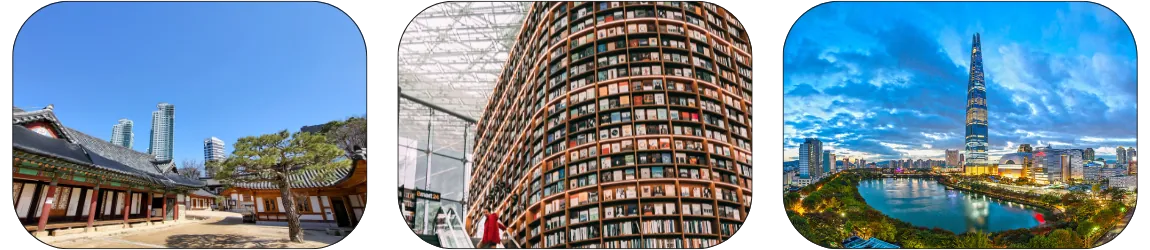
On the sixth day, we head to the Gangnam district, famous not only for PSY’s “Gangnam Style,” but also as the headquarters of Korea’s largest multinational companies and the home of many actors and celebrities. Later, the itinerary continues to Jamsil for a visit to the Lotte World Tower.
Bongeunsa Temple
The Bongeunsa Temple was one of the first places I visited in Seoul, and it’s an absolute must if you’re exploring Gangnam. This important Buddhist temple can be reached directly from Bongeunsa Station on Line 9. Alternatively, you can use Samseong Station (Line 2, about 600 meters away) or Cheongdam Station (Line 7, about 800 meters away). Deeply significant in the history of Korean Buddhism, Bongeunsa is a site you should not miss.
COEX Mall
Right across from the temple is the famous COEX Mall, the largest underground shopping center in Asia. Its most iconic attraction is the Starfield Library, a spectacular open library you’ve probably already seen on social media. Inside, you’ll also find the COEX Aquarium, a great stop especially if you’re traveling with kids. For lunch, choose one of the many restaurants inside the mall, where you’ll find both local and international cuisine.
Gangnam
After lunch, it’s time to dive into the heart of Gangnam. Start with a quick photo stop at the statue dedicated to the global hit “Gangnam Style,” then explore the grand avenues of one of Seoul’s wealthiest neighborhoods. From Samseong Station, take the subway to Gangnam Station. Right outside, you’ll spot one of Samsung’s headquarters — four distinctive square skyscrapers that are hard to miss. Beneath the building, there’s a Samsung store with exclusive accessories you won’t find in Europe.
From there, stroll along Gangnam-daero toward Sinnonhyeon. The area is packed with stylish cafés, perfect for an afternoon dessert break. Don’t miss the Kakao Friends store, which also includes a themed café — a favorite for K-culture fans.
Lotte World Tower
End the day with a visit to the Lotte World Tower, one of Seoul’s most famous landmarks. Standing at 555 meters, it is the sixth tallest skyscraper in the world. Climb up to Seoul Sky, the observatory located on the top six floors, for an unforgettable sunset view of the city. We recommend buying your Seoul Sky tickets online to save money and skip the lines.
At the base of the tower is a large shopping mall, while just outside you’ll find Seokchon Lake, especially famous in spring when cherry blossoms surround its shores, and the Lotte World amusement park.
To finish the day, head toward Olympic Park. On Olympic-ro 32-gil and the nearby streets, you’ll find plenty of restaurants and Korean BBQ spots, perfect for ending your day with a delicious dinner.
I always recommend leaving the last day of your Seoul trip free. This way, if during the week you missed something on your itinerary, you’ll have time to catch up and visit it without rushing. Alternatively, you can dedicate the day to shopping for last-minute gifts and souvenirs to bring back home. For this, Myeongdong and Insadong are the best neighborhoods: Myeongdong for its endless cosmetics, fashion, and street food stalls, and Insadong for its art shops, antiques, tea houses, and traditional crafts. Both are perfect places to end your trip with a mix of culture, atmosphere, and shopping.
If you still have time left on your last day, or during other parts of your trip, here are some additional places and experiences in Seoul worth considering:
If you’d like to take a day trip outside the city, there are several locations to visit near Seoul:
This itinerary is designed as a starting point, especially for those visiting Seoul for the first time, so you’ll know exactly what to do and what to see. If you’ve already been to Seoul, or if you prefer certain types of attractions over others, feel free to adapt it by adding or removing destinations. The best itineraries are always those that match your personal preferences — and Seoul, being such a diverse city, offers endless possibilities. Now is the perfect time to take pen and paper and adjust this itinerary to your liking. However, if you’re staying in the city for fewer than 3 days, I recommend reading the shorter article dedicated to the Top 10 attractions in Seoul.
 Italiano Italiano Italiano
  English Italiano Italiano Italiano English