Changdeokgung Palace is one of the Five Grand Royal Palaces of Seoul built during the Joseon Dynasty, and is also known as the "Eastern Palace" because of its location to the east. The entire complex is recognized as a UNESCO World Heritage Site.
Changdeokgung was favored by many Korean rulers during the medieval period, and it preserves distinctive elements of Korean architecture from the Three Kingdoms era. Its most notable feature is the way the palace harmonizes with the surrounding natural landscape rather than dominating it.
Construction began in 1405 and was completed in 1412, during the reign of King Taejong. Later, King Sejo expanded the palace grounds by about 500,000 square meters. During the Japanese invasion of 1592, Changdeokgung was destroyed by fire, but it was rebuilt in 1610. Despite another fire in 1623 and later attacks from the Ming Dynasty, as well as during the French and U.S. military expeditions, the palace was continually restored while maintaining its original style.
Until 1867, Changdeokgung served as the seat of government, after which the nearby Gyeongbokgung was rebuilt and took its place. The last Korean monarch, Sunjong, lived here until his death in 1926.
Today, Changdeokgung is considered the best-preserved of Seoul’s royal palaces and historically ranked as the second most important after Gyeongbokgung.
Guided tours of Changdeokgung Palace
As always, we have selected the best guided tours so that you can visit Changdeokgung Palace with a local guide. This way you will gain an even deeper understanding of the history and architecture of this extraordinary palace.
This tour not only includes Changdeokgung but also the Seoul Museum of Korean Folk Music, the first museum in Korea dedicated to folk music, and the Traditional Liquor Gallery, where you can taste traditional liquors from eight different Korean regions. The tasting is included in the guided tour (available soon).
This option allows you to visit several royal palaces in one tour. You can choose between the morning, afternoon, or full-day version. The full-day tour is highly recommended for those with limited time in Seoul, as it is very comprehensive and intense.
This tour focuses on Changdeokgung, but also includes a visit to Unhyeongung Palace and the Insadong neighborhood. It is an excellent choice for those who want a cultural experience at a very affordable price.
Opening hours of Changdeokgung Palace
From January to February: 09:00 / 17:00
From March to May: 09:00 / 18:00
From June to August: 09:00 / 18:30
From September to October: 09:00 / 18:00
From November to December: 09:00 / 17:00
Last admission: 1 hour before closing
Guided tours of the Secret Garden (Huwon):
From December to February: 10:30 / 11:30 / 14:30
From March to November: 10:30 / 11:30 / 14:30 / 15:30
You can enter the Secret Garden only by joining a guided tour.
The palace and the garden are closed on Mondays.
Tickets and admission fees
Tickets to enter Changdeokgung Palace can be purchased directly at the ticket offices on site. Here are the prices in detail: PChangdeokgung Wing: Adults (19 to 64 years old): 3,000 won, children (7 to 18 years old): 1,500 won Children under 7, over 65 and people wearing a Hanbok (traditional Korean dress) and during Culture Culture Day (last Wednesday of each month): free admission
Changdeokgung Palace + Guided Tour of the Secret Garden (Huwon):
Adults (19–64 years old): 8,000 KRW
Youth (7–18 years old): 4,000 KRW
Seniors over 65: 5,000 KRW
Royal Palace Pass: for 10,000 KRW you can purchase a combined ticket valid for three months that allows one-time entry to four royal palaces in Seoul (Gyeongbokgung, Changdeokgung – including the Secret Garden, Changgyeonggung, Deoksugung) plus Jongmyo Shrine.
How to get to Changdeokgung Palace
Take Subway Line 3 and get off at Anguk Station (Exit 3). The palace is about a 6-minute walk from the station.
Alternatively, take Subway Line 1, 3, or 5 and get off at Jongno 3-ga Station (Exit 6). From there, it’s about a 10-minute walk.
Address: 99, Yulgok-ro, Jongno-gu, Seoul
The buildings and architecture of Changdeokgung Palace
Changdeokgung Palace had a major influence on the development of Korean architecture, especially in terms of garden design and its impact on the surrounding landscape. It stands out as a remarkable example of architecture perfectly integrated with the natural environment, adapting to the terrain and preserving the existing vegetation.
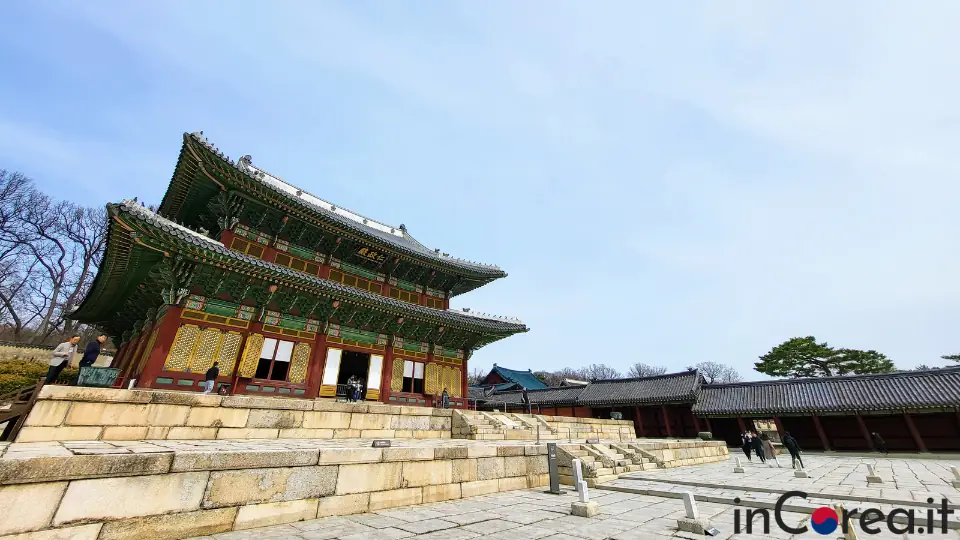
Today, the complex includes 13 buildings and 28 pavilions within its gardens, covering a total area of about 45 hectares. Among the most important structures are Donhwamun, the main entrance to the palace; Injeongjeon, the two-story main hall symbolizing royal authority; Seongjeongjeon, the auxiliary office where the king worked; Huijeongdang, the king’s residence; Daejojeon, the queen’s residence located behind the king’s quarters; and Nakseonjae, used as the king’s private study and offices.
Following the principles of Feng Shui, the palace is located near Mount Bugaksan, with its main buildings oriented to the south and its garden extending north. Unlike other palaces, the arrangement of Changdeokgung’s structures is freer and less rigid, as most Korean palaces were traditionally built on a strict north-south axis. This difference makes Changdeokgung unique, as each building was designed in harmony with its natural surroundings.
The palace is divided into two main areas: the government section (Injeongjeon and Seonjeongjeon) and the private section, which housed the royal family’s apartments. Its architectural style is characterized by simplicity, reflecting the principles of Confucianism.
Secret Garden Huwon
The so-called Huwon Secret Garden, located at the back of the palace, was reserved exclusively for the royal family. Today, visitors can only access it by joining guided tours that depart every 90 minutes (tickets are available at the entrance, as explained in the admission section). The garden offers a truly picturesque setting with a lotus pond, traditional pavilions, centuries-old trees, and seasonal flowers. More than 26,000 plant specimens, belonging to around one hundred different species, thrive here. Notable trees include walnut, white oak, zelkova, plum, maple, chestnut, hornbeam, yew, gingko, and pine.
The section reserved for the king was called Geumwon, or the “forbidden garden,” as it was once accessible only to the ruler. Huwon was often the stage for royal ceremonies, games, and festivals. The area known as Ongnyucheon features a U-shaped waterway created in 1636, along with five elegant pavilions that highlight the beauty and harmony of this unique royal garden.
We've detected you might be speaking a different language. Do you want to change to:

 Italiano
  English