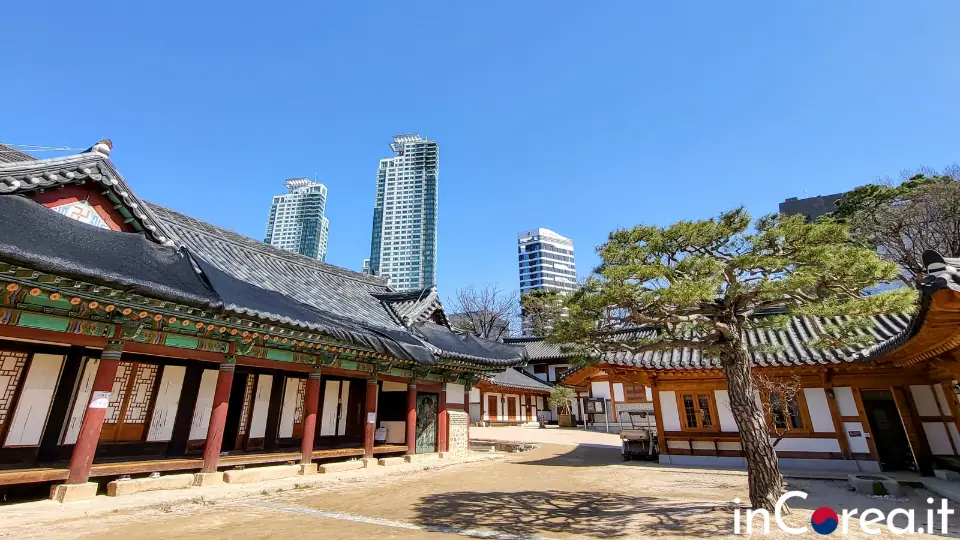
Bongeunsa Temple (봉은사) is an ancient Buddhist temple located in Samseong-dong, within Gangnam-gu, Seoul, South Korea. It was founded in 794, during the reign of King Wonseong, by the monk Yeonhoe, one of the highest-ranking monks of the Silla Kingdom. Originally named Gyeonseongsa, the temple sits on the slopes of Sudo Mountain, directly across from the modern COEX Mall.
During the Joseon Dynasty, Buddhism in Korea faced heavy suppression. However, the temple was rebuilt in 1498 under the patronage of Queen Jeonghyeon, consort of King Seongjong, and renamed Bongeunsa. The name Bongeunsa carries the meaning of “honoring the king,” which in this context can be interpreted as a prayer for the eternal life of King Seongjong.
In the 16th century, Queen Munjeong briefly revived Buddhism in Korea and greatly supported Bongeunsa. Thanks to her patronage, the temple became the main center of Seon Buddhism in Korea from 1551 until 1936. In 1548, Queen Munjeong appointed the monk Bou as the head of the temple, but he was killed shortly after as anti-Buddhist forces regained power toward the end of her reign.
In 1902, Bongeunsa Temple was designated as one of the 14 major temples of the Korean Empire. During the Japanese occupation, it became the administrative center for more than 80 smaller Buddhist temples around Seoul. In 1922 and again in 1929, the chief monk Cheongho famously saved over 700 people from drowning in the Han River — a heroic act that led to the erection of a monument in his honor and further elevated the temple’s significance. After the colonial period, Bongeunsa was incorporated into the Jogye Order, the largest Buddhist sect in Korea.
A devastating fire in 1939 destroyed most of the temple buildings, and further damage occurred during the Korean War. Fortunately, the Panjeon Hall survived, preserving valuable parts of the Flower Garland Sutra carved in 1855 by the monk Yeonggi. This hall remains one of Bongeunsa’s most treasured cultural assets.
Since then, the temple has undergone extensive repairs and renovations. Today, Bongeunsa Temple is once again a large, thriving complex, with ongoing restoration and preservation efforts ensuring that its history and cultural heritage are kept alive for future generations.
Bongeunsa Temple opening hours
The Bongeunsa Temple in Seoul is open every day of the year, from 5:00 AM to 10:00 PM. These opening hours allow visitors to enjoy the temple’s peaceful atmosphere at both sunrise and sunset, when the grounds are beautifully illuminated. Admission is free, and no reservation is required. For a quieter and more authentic experience, it’s best to visit early in the morning or later in the evening, when there are fewer tourists.
If you’d like to explore the temple in more depth with a guide, book this tour that includes a guided visit to Bongeunsa Temple, a stop at the nearby Starfield Library, and a delicious lunch or dinner at an authentic Korean BBQ restaurant.
The Bongeunsa Temple is located in the famous neighborhood of Gangnam-gu, proprio di fronte al COEX Mall. Si può facilmente raggiungere con diverse linee della metropolitana:
Line 9: Get off at Bongeunsa Station, Exit 1 – the temple is just 100 meters away.
Line 2: Get off at Samseong Station, Exit 6 – about a 600-meter walk.
Line 7: Get off at Cheongdam Station, Exit 2 – about 800 meters away. While this is the farthest option, it’s convenient if you’re traveling on Line 7.
Address: 531, Bongeunsa-ro, Gangnam-gu, Seoul
Templestay at Bongeunsa Temple
Bongeunsa Temple is part of the Templestay program, a unique cultural initiative that allows visitors to experience the daily life of Buddhist monks. Depending on your availability and interest, you can choose between two options:
2-Hour Templestay: includes a guided tour of the temple, participation in a traditional tea ceremony, and Sagyeong — the meditative practice of hand-copying Buddhist sutras.
2-Day, 1-Night Templestay: a more immersive experience that gives participants the chance to live like a monk, following temple routines and practices. This program is more demanding but offers a much deeper insight into Korean Buddhist culture.
Bongeunsa Temple is not only one of Seoul’s most popular tourist destinations, but also a living center of Korean Buddhism. As mentioned earlier, it offers unique programs such as the Templestay experience for those who wish to immerse themselves in monastic life, even if just for a day.
The temple preserves an extraordinary collection of 3,479 Buddhist scriptures across 13 different categories, including the works of the renowned scholar Kim Jeong-hee.
Every year, on the ninth day of the ninth month in the lunar calendar, Bongeunsa hosts the Jeongdaebulsa ceremony. During this sacred ritual, monks solemnly parade through the temple grounds, carrying scriptures on their heads while chanting the Beopseongge — a deeply spiritual performance that creates a truly unique atmosphere.
Bongeunsa also holds a special place in the history of Korean Buddhism. In front of the main gate stands a modest stone monument inscribed with “Seongkwa-pyung’on,” marking the site of the National Buddhist Examination (1552–1564). This examination selected Buddhist masters whose dedication helped Buddhism endure and flourish, keeping Bongeunsa a vital temple to this day.
We've detected you might be speaking a different language. Do you want to change to:

 Italiano
  English