
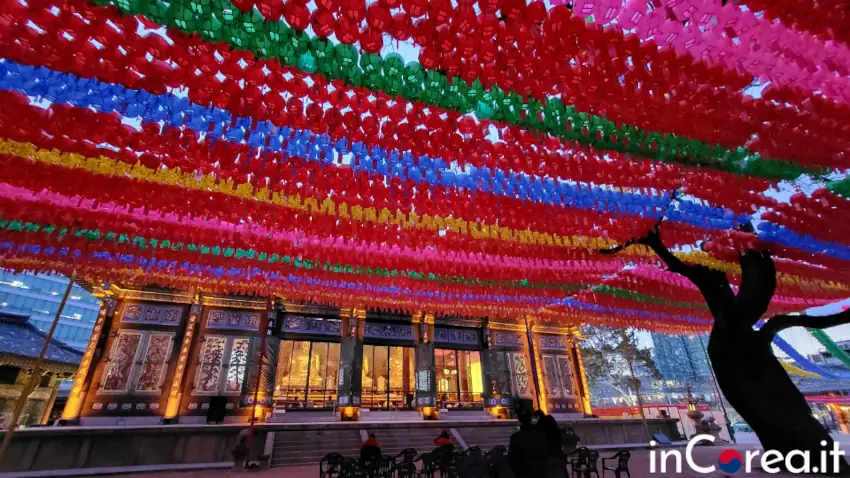
The Jogyesa Temple (조계사 in Korean, literally “Jogye Temple”) is the heart of the Jogye Order of Korean Buddhism. Originally built in 1395, it officially became the main temple of the order in 1936, standing today as a significant center of Seon (Zen) Buddhism in South Korea. Its current structure dates back to 1910, when it was rebuilt after a fire and named Gakhwangsa. Over the years, the temple underwent several name changes: during the Japanese colonial period it was known as “Taegosa,” and in 1954 it acquired its present name, Jogyesa.
Located in Gyeonji-dong, Jongno-gu, in the heart of Seoul, Jogyesa is home to Natural Monument No. 9, a majestic ancient white pine that has become one of its symbols. The temple is also located near Insa-dong, one of Seoul’s most renowned cultural areas, and Gyeongbokgung Palace.
One of Jogyesa’s distinctive experiences is the Templestay program, which allows visitors to immerse themselves in monastic life, enjoy traditional Buddhist cuisine, and deepen their understanding of the temple’s history and Korean Buddhism.
During the Japanese colonial era (1910–1945), Jogyesa became a stronghold of Korean Buddhism, serving as a symbol of resistance against Japanese efforts to suppress Buddhist practices in Korea.
As always, we select the best guided tours for travelers who truly want to learn more about the temple and its history. We recommend the Palace Tour, available both as a morning tour and a full-day experience, which also includes a visit to Jogyesa Temple. You’ll find the booking link in the button below.
Jogyesa Temple is located in Jongno-gu District, just a 10-minute walk from Insadong. Thanks to its central position, it is easily accessible by several subway lines:
Address: 55, Ujeongguk-ro, Jongno-gu, Seoul
The Baeksong, a majestic specimen of white pine, stands near Daeungjeon, the temple’s main hall, and holds the prestigious designation of Natural Monument No. 9 in Korea. With an estimated age of 500 years, this rare species—native to China but uncommon in Korea—is renowned for its slow growth, limited reproduction, and distinctive white bark. Reaching a height of 14 meters with a trunk circumference of 1.85 meters, the Baeksong has endured through centuries thanks to the devoted care it has received. When Jogyesa Temple was relocated to its current site, this venerable tree was also moved, continuing its journey alongside the temple. Today, it remains one of Seoul’s most admired attractions and is often decorated with lanterns, especially during the Lotus Lantern Festival.
The Pagoda Tree, also known as the Chinese Scholar Tree, is an ornamental plant admired for its clusters of white summer blossoms and small fruits that appear in October. The specimen at Jogyesa Temple is over 450 years old and towers at a height of 26 meters. Traditionally, this tree is believed to ward off negative energy and bring good fortune, which is why it is often found in temple and palace grounds. Its name, “Chinese Scholar Tree,” comes from its dignified and elegant form, which is said to resemble that of a learned scholar.
Daeungjeon, the temple’s main hall, stands out for its imposing size. Staircases are located on all sides, and its doors are decorated with intricate floral patterns. Wooden panels are painted with vibrant images depicting the life and teachings of the Buddha.
Inside, visitors are immediately struck by the three massive Buddha statues: the one on the left represents Amitabha, the Buddha of Western Paradise; the one on the right depicts Bhaisajyaguru, the Medicine Buddha, holding a bowl; while the central figure is the historical Buddha, who attained enlightenment in India.
Upon entering the hall, worshippers find on the right side an altar with paintings of powerful guardians, while the left altar is traditionally used for funeral services. Devotees bow three times—once to the Buddha, once to the Dharma (teachings), and once to the Sangha (monastic community). About 20 monks currently serve at Jogyesa. Outside the hall, candles, symbolizing the Buddha dispelling ignorance, and incense sticks enhance the sacred atmosphere.
Behind the main sanctuary stands the more modern Amitabha Buddha Hall, primarily used for funerals. Here, ten statues act as judges to determine, 49 days after death, whether a soul should go to heaven or hell. The temple’s bell tower houses several ritual instruments: a large drum to summon earthly beings, a wooden fish-shaped gong for aquatic creatures, a metal cloud-shaped gong for birds, and a bronze bell to call underground beings. The great bell is rung twice a day: 28 times at 4:00 a.m. when the monks’ day begins, and 33 times at 6:00 p.m.—a deeply moving ritual that is worth experiencing.
Within the complex, visitors can also find a small Buddhist museum with paintings and relics, a tranquil tea room, and a foreign information center run by English-speaking guides. Finally, the Jinsinsari Pagoda enshrines a sacred relic of Sakyamuni Buddha, donated in 1913 by the Sri Lankan Zen master Dharmapala.
The Lotus Lantern Festival celebrates the Buddha's birthday and is the most important Buddhist holiday in South Korea. It takes place every year on the eighth day of the fourth lunar month, which usually falls between late April and early May. In the weeks leading up to the festival, Seoul becomes beautifully decorated with colorful lotus-shaped lanterns. The celebration officially begins with the lighting of the Jangeumdang, a large lantern symbolizing Buddhism and the Buddha’s birth, at Seoul Plaza. From there, a variety of Buddhist events and cultural activities animate the city, culminating in a spectacular lantern parade through central Seoul that ends in front of Jogyesa Temple.
At the close of the procession, participants join together in lively group dances led by entertainers. Throughout the festival area, stalls offer hands-on activities such as making your own lotus lantern or crafting a Buddhist rosary. Others showcase the Buddhist heritage of countries like Mongolia, Thailand, and India. Visitors can also try on a traditional hanbok or take part in a reenacted Korean wedding ceremony, making the festival not only spiritual but also deeply cultural and immersive.
If you’re looking to plan your trip to South Korea around this wonderful festival, the Lotus Lantern Festival (Yeondeunghoe) will take place on May 8–9, 2027.
 Italiano Italiano Italiano
  English Italiano Italiano Italiano English