
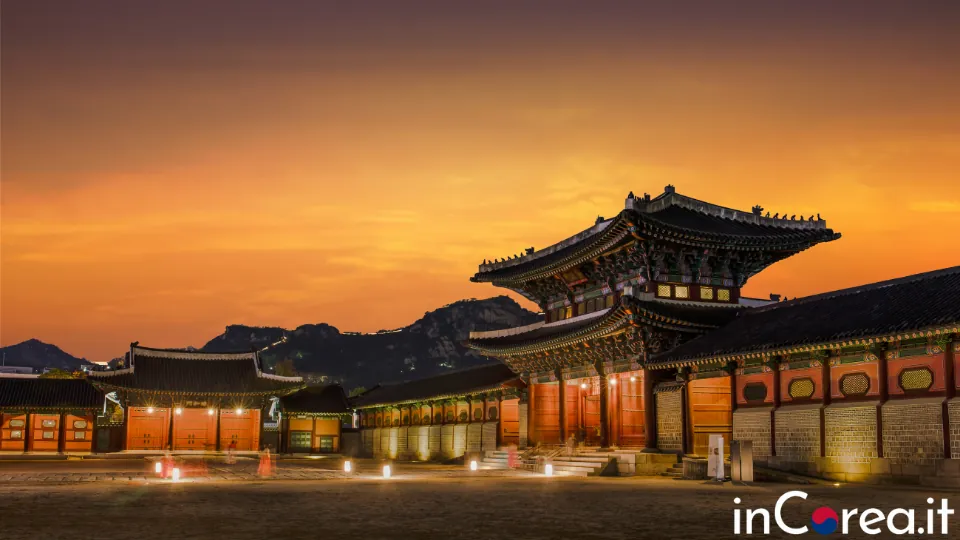
Gyeongbokgung Palace

Gyeongbokgung Palace in Seoul, South Korea
Article Index

History of Gyeongbokgung Palace

Gyeongbokgung Palace is the largest and most important of the royal palaces of Seoul and is ranked among the top attractions to visit in the city, thanks to its historical significance. Built in 1395 by King Taejo, the founder of the Joseon Dynasty, the palace is located in the northern part of the capital. It served as the royal residence and the main seat of government.

In 1592, Gyeongbokgung Palace was destroyed by Japanese forces during the Imjin War. The ruins remained untouched for nearly 270 years until 1867, when King Gojong’s government initiated a major restoration project. Unfortunately, in 1911, during the Japanese occupation, the palace was demolished once again, and the Japanese Governor-General Building was constructed directly in front of the throne hall.

Since 1990, continuous restoration works have been underway to return Gyeongbokgung to its original appearance. To achieve this, the Japanese Governor-General Building was demolished in 1996, and iconic structures such as Heungnyemun Gate and the Gwanghwamun Gate were carefully rebuilt.

Today, Gyeongbokgung Palace also hosts the National Palace Museum of Korea and the National Folk Museum of Korea. Just behind the palace rises Mount Bugak. Following the assassination of Queen Myeongseong by Japanese agents in 1895, the Joseon Imperial Family never returned to reside within the palace.

Guided tours and experiences at Gyeongbokgung Palace

Thanks to our partner Trazy, you can book English-speaking guided tours of Gyeongbokgung Palace. Exploring the site with an expert local guide will give you a deeper understanding of its history and allow you to experience it in a more immersive way. A special highlight is the Gyeongbokgung Palace Night Opening, available during selected evenings in September and October.

Join a guided tour that focuses on the main halls, pavilions, and highlights of the palace.

Choose between morning, afternoon, or a full-day program that includes multiple royal palaces. The full-day option is highly recommended for travelers with limited time in Seoul, as it offers an in-depth cultural experience.

Wearing a hanbok, Korea’s traditional attire, allows you to enter Gyeongbokgung Palace for free. You can also book a professional photoshoot inside the palace or in a traditional Korean house, capturing unique and memorable photos in authentic locations.

Opening hours of the Gyeongbokgung Palace

  • January – February: 09:00 – 17:00 (last admission 16:00)
  • March – May: 09:00 – 18:00 (last admission 17:00)
  • June – August: 09:00 – 18:30 (last admission 17:30)
  • September – October: 09:00 – 18:00 (last admission 17:00). During this season, the Gyeongbokgung Palace Night Opening often takes place, allowing visitors to enjoy the palace in the evening from 19:00 to 21:30. This atmospheric event is highly recommended.
  • November – December: 09:00 – 17:00 (last admission 16:00)
Closed on Tuesdays.

Tickets and admission fees

Tickets can be purchased directly at the on-site ticket offices. The admission fee is 3,000 KRW for adults aged 19 to 64. Free entry is granted to:

  • Visitors aged 18 or younger
  • Seniors aged 65 or older
  • Anyone wearing a hanbok
  • On the last Wednesday of every month (known as Culture Day)
For groups of at least 10 people, the ticket price is 2,400 KRW per person.
Another option is the Royal Palace Pass, which costs 10,000 KRW and allows single entry to five major sites in Seoul within a three-month period: Gyeongbokgung, Changdeokgung (including the Secret Garden), Changgyeonggung, Deoksugung, and Jongmyo Shrine.

How to get to Gyeongbokgung Palace

Gyeongbokgung Palace is easily accessible by public transportation.

  • By subway: Take Line 3 and get off at Gyeongbokgung Station. Use Exit 5 for direct access to the palace entrance.
  • By bus: The palace is also served by the Seoul City Tour Bus (Route B), which stops near the main gate.

Address: 161 Sajik-ro, Jongno-gu, Seoul, 03045

The access gates to Gyeongbokgung Palace

In addition to the massive walls surrounding the palace complex, there are three main gates providing access to Gyeongbokgung Palace.

  • Gwanghwamun
    Known not only as the name of the nearby square but also as the main gate of Gyeongbokgung Palace, Gwanghwamun was destroyed during the Japanese occupation, leaving only its stone base. Restoration began in 1968 under President Park Chung-hee, when a concrete reconstruction replaced the original wooden structure. In August 2010, an authentic pine wood gate was completed, replacing the concrete version. The area in front of the gate, Gwanghwamun Plaza, was once home to important government buildings of the Joseon era and served as the political and economic center of the dynasty. Today, visitors can see the statues of Admiral Yi Sun-sin and King Sejong. In October 2023, the altar in front of the gate was also restored, returning it to its original appearance.
  • Geonchunmun
    Geonchunmun is the eastern gate of the palace, also known as the Spring Gate, in line with the ancient belief that the east symbolized spring. The gate is marked by a large arch topped with a tower. Guards could reach the tower using two steep stone stairways on either side. Two side entrances provide access to the palace walls. The ceiling is decorated with vivid paintings of clouds and dragons in blue, red, white, yellow, and black. The Blue Dragon is located to the east, while the Yellow Dragon is positioned to the west. Both dragons have five claws and hold a magic orb in their jaws, symbolizing royal authority.
  • Yeongchumun
    Opposite the Spring Gate, the western gate represents autumn, and is therefore known as the Autumn Gate. In the past, a stream flowed just beyond this entrance, although today it has been covered and is no longer visible.

All buildings in Gyeongbokgung Palace

Korean palaces, unlike Western ones, are made up of several separate buildings, some connected and some independent. Below is a guide to the main structures inside Gyeongbokgung Palace. We recommend using this list during your visit to better understand the origin and function of each space.

  • Gyeonghoeru
    One of the most iconic structures in Gyeongbokgung is the Gyeonghoeru Pavilion, built in 1412. The rectangular building is surrounded by an artificial pond and was used for state events, including royal banquets, receptions for foreign envoys, and seasonal rituals. Destroyed in 1592 during the Japanese invasions, it was reconstructed in 1867. The pavilion rests on 48 massive stone pillars: square ones on the exterior and cylindrical ones inside.
  • Geunjeongjeon
    The Geunjeongjeon Hall is the throne hall and the heart of the palace. It was the setting for official royal duties and meetings with foreign envoys. Between 1399 and 1546, seven monarchs were crowned here. Originally built in 1394 during the third year of King Taejo’s reign, the hall was destroyed in 1592 and rebuilt in 1867 by King Gojong. Its single-story design features a majestic ceiling symbolizing royal authority. At the center of the rear wall stands the throne, once surrounded by ritual objects now lost. The ceiling is decorated with clouds and two dragons fighting over a jeweled orb, symbolizing the sovereign.
  • Sajeongjeon, Manchunjeon, and Cheonchujeon
    The Sajeongjeon Hall was where the king managed his daily affairs. To its east stood Manchunjeon Hall, and to the west Cheonchujeon Hall. After the Korean War (1950–1953), only the foundation of Manchunjeon remained, but it was rebuilt in 1988 with a more restrained design compared to Sajeongjeon. Cheonchujeon Hall, constructed to balance Manchunjeon on the west side, played a significant cultural role prior to the 16th-century invasions. Despite its modest size, it was highly important.
  • Sujeongjeon
    Before Sujeongjeon, King Sejong had built Borugak and Heumjeonggak near Gyeonghoeru Pavilion. After their destruction in the Japanese invasions, King Gojong replaced them in 1867 with Sujeongjeon Hall, which became one of the palace’s most notable spaces. During the imperial period, it housed the Office of the Gungukgimucheo and later served as a government office. It was once surrounded by smaller buildings for doctors, guests, and messengers, but these were eventually demolished.
  • Amisan
    Named after a mountain in China, Amisan is a garden mound located behind the queen’s residence. It features four long rectangular terraces decorated with flowerbeds and unique hexagonal chimneys belonging to Gyotaejeon Hall, the queen’s quarters. The chimneys are beautifully adorned with animal motifs (dragons, cranes, bats), floral symbols (peonies, plum blossoms, chrysanthemums, bamboo, and pine), and Chinese characters.
  • Jagyeongjeon
    This building was the residence of Queen Mother Jo, mother of King Heonjong (r. 1834–1849). Commissioned by Heungseon Daewongun, the father of King Gojong, it was rebuilt in 1888 after being demolished. Jagyeongjeon is unique because it contains the palace’s only surviving bedroom. The room features traditional ondol underfloor heating, while a pavilion to the southeast was designed for summer use. The interior walls are decorated with motifs of the ten symbols of longevity, while the chimneys and doorways feature colorful designs of dragons, cranes, and flowers.
  • Hamhwadang and Jipgyeongdang
    Hamhwadang Hall stands west of Jipgyeongdang Hall, to which it is directly connected. Originally surrounded by corridors and a walled enclosure, most of these structures were later demolished. Both halls were part of Heungbokjeon, the royal living quarters located north of Amisan. During the Japanese colonial period, they were repurposed as museum offices.
  • Hyangwonjeong
    Set in the rear gardens is Hyangwonjeong Pavilion, built in 1873 on a small island at the center of a pond first created in 1456. The pavilion is connected to the shore by a graceful wooden bridge called Chuihyanggyo. The area is decorated with aquatic plants, carp, and carefully cultivated azaleas, making it one of the most picturesque and romantic spots in the palace.