Bukchon Hanok Village: Seoul’s traditional Hanok neighborhood
Article Index
History of Bukchon Hanok Village
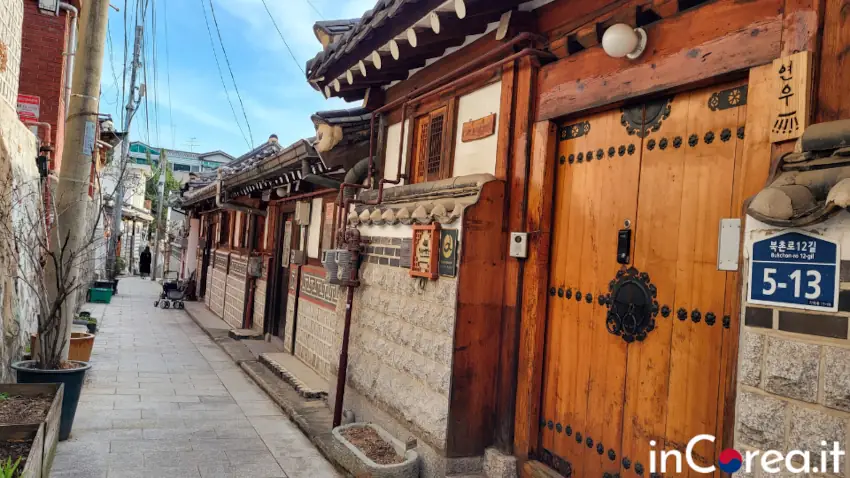
Bukchon Hanok Village is a historic area of Seoul where you can find hundreds of hanok, the traditional Korean houses. The name literally means “northern village,” as it is located in the northern part of the old city of Seoul. It is one of the best-preserved hanok neighborhoods in Korea, although many of the houses have been adapted into guesthouses, cultural centers, cafés, restaurants, and shops, so it does not look exactly as it did in the past.
During the Joseon Dynasty, Bukchon was home primarily to the nobility and aristocracy. Around 1906, the neighborhood had a population of about 10,000 residents, compared to roughly 7,000 today.
Between the 1970s and 1980s, the area underwent significant transformation. Many residents were relocated from Gangbuk, and schools in the area were moved to Gangnam. In their place, major institutions were established, including the Jeongdok Public Library, the Constitutional Court of Korea, and a large 15-story office building once occupied by Hyundai Engineering & Construction Co.
This period marked a turning point, as new local policies attempted to preserve hanoks through a strict control system. However, these initiatives also led to the demolition of many houses in order to widen streets, sparking inconvenience and protests from residents who had not been consulted.
Between 1991 and 1994, the Seoul Metropolitan Government raised the permitted building height in Bukchon, first to 10 meters and later to 16 meters (about five stories). This policy accelerated the construction of taller buildings and the demolition of hundreds of traditional hanoks throughout the neighborhood.
In response, the Jongno Bukchon Readjustment Association, a residents’ group, requested the Seoul Institute in 1999 to develop a new readjustment policy that would involve residents, experts, and the Seoul Metropolitan Government. This effort resulted in the creation of a voluntary hanok registration system in 2001, along with preservation policies that provided financial support for maintenance and promoted the adaptation of traditional hanoks for modern living.
Hanok Stay - Sleeping in a traditional house
One of the most fascinating aspects of Bukchon’s transformation is the opportunity to stay in Bukchon Hanok Village inside an authentic Korean hanok. Experiencing a night in a hanok allows you to sleep within ancient wooden walls, enjoy floors warmed by the traditional ondol heating system, and relax in serene courtyards that reflect centuries of history.
To help you find the perfect option, we’ve selected the best hanok stays in Bukchon, balancing authenticity, comfort, and value for money. As always, we include budget-friendly, mid-range, and luxury choices so every traveler can experience this unique part of Korean culture.
Luxury Hanok Stay HyeonhyeonJae (with a private bathroom) Gouheon (with a private bathroom) Mionga (with a private bathroom)
How to get to Bukchon Hanok Village
Bukchon Hanok Village is located between Gyeongbokgung Palace and Changdeokgung Palace, slightly to the north. The easiest way to reach it is by taking Subway Line 3 to Anguk Station. From Exit 3, simply follow the signs, and within a few minutes you’ll arrive at the village.
Guided tours in Bukchon Hanok Village
If you really want to discover the history of Bukchon Hanok Village, the best choice is to join a guided tour. Exploring with a knowledgeable local guide not only helps you understand the stories behind the hanok houses and alleyways, but also gives you a deeper appreciation of Korean culture.
We recommend this 2-hour walking tour, where an experienced guide will lead you through Bukchon’s most fascinating alleys, sharing history and hidden details along the way. The tour also includes a traditional tea or coffee break, making the experience both cultural and relaxing. It’s a unique and affordable alternative to standard guided tours, offering excellent value for money.
Within Bukchon Hanok Village, there are several cultural sites worth exploring:
Bukchon Traditional Culture Center: a multipurpose cultural venue offering hands-on experiences. Visitors can attend traditional calligraphy classes, take part in tea ceremonies or pansori (Korean musical storytelling), and join workshops on local handicrafts. The center also hosts cultural events focused on hanok houses, along with concerts and film screenings.
Seoul Intangible Cultural Heritage Center: established to promote and preserve Korean handicrafts, this center features exhibitions of traditional artifacts. Skilled artisans hold classes to pass down these crafts to the next generation.
Bukchon Asian Art Museum: a small museum showcasing Korean and Asian paintings, as well as cultural artifacts.
Gahoe Museum: home to over 2,000 folk paintings and traditional crafts. Visitors can also take part in lessons on Korean folk painting.
Other interesting stops include the Han Sangsu Embroidery Museum, dedicated to traditional Korean embroidery, and the Owl Museum, a quirky museum-café with more than 2,000 owl-themed artifacts from around the world. You’ll also find numerous cafés, restaurants, and art galleries in the area, including the well-known Daelim Museum.
Important tip: while exploring Bukchon Hanok Village, keep in mind that it’s still a residential neighborhood. Please speak quietly, respect residents’ privacy, and follow basic rules of courtesy.
We've detected you might be speaking a different language. Do you want to change to:

 Italiano
  English