
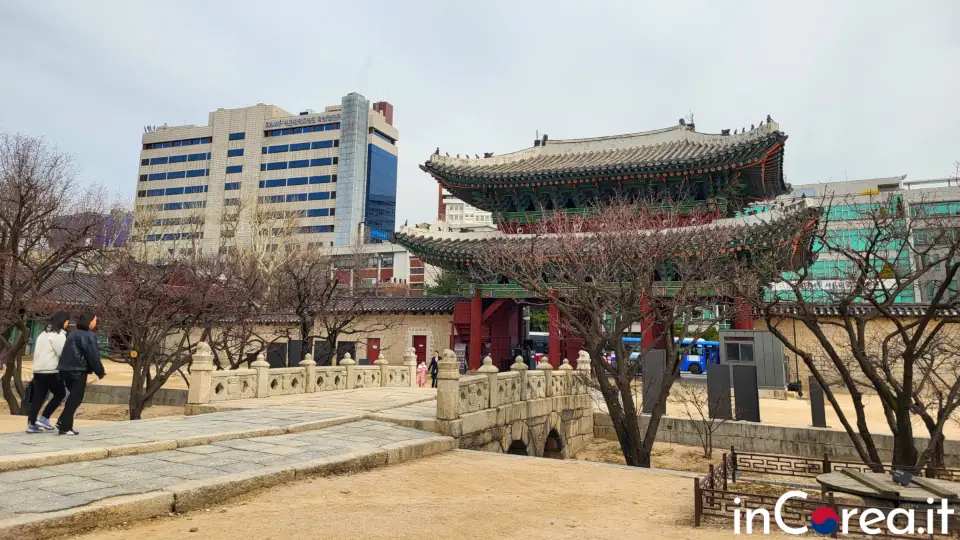
Changgyeonggung Palace

Changgyeonggung Palace in Seoul, South Korea
Article Index

History of Changgyeonggung Palace

Built in the mid-15th century by King Sejong for his father Taejong under the name Suganggung, Changgyeonggung Palace is one of the royal palaces of Seoul. Later, in 1483, King Seongjong not only gave it its current name but also expanded and restored the complex.

Like many of Seoul’s palaces, Changgyeonggung was destroyed during Japan’s repeated invasions between the 15th and 16th centuries. Rebuilt afterward, it was once again destroyed in the early 1900s during the Japanese occupation, when it was transformed into a park similar to Ueno Park in Tokyo.

During that period, a zoo, a botanical garden, and a museum were established, and the palace was renamed Changgyeongwon Park. After Korea regained independence in 1945 and endured the Korean War (1950–1953), the zoo was rebuilt with donations from wealthy Koreans and gifts from foreign zoos. In 1983, the zoo and botanical garden were relocated to Seoul Grand Park, allowing Changgyeonggung to be restored to its original appearance.

Compared to the other royal palaces, Changgyeonggung is smaller and features a simpler architectural style. It is directly connected to Changdeokgung and located east of the main Gyeongbokgung Palace, which is why it is also called Donggwol, meaning “the Eastern Palace.”

Guided tours and experiences

Changgyeonggung Palace is included as one of the stops on the popular Seoul Night Tour. This evening guided tour departs from Hongik University Station (Hongdae) and Myeongdong Station. In addition to the palace, other highlights include Gwangjang Market, one of Seoul’s oldest and most famous food markets; Naksan Park, offering breathtaking night views of the city; and the illuminated Cheonggyecheon Stream. At the end of the tour, you will be dropped off at either Myeongdong Station or Hongik University.

The price covers transportation, entrance tickets to attractions, and the services of an experienced English-speaking guide. Click the button to check the full itinerary and current price.

Opening hours of Changgyeonggung Palace

January – December: 09:00 – 21:00 (last entry at 20:00)

Closed on Mondays.

Tickets and admission fees

Tickets can be purchased directly at the on-site ticket office for 1,000 won for adults aged 19 to 64.

As with the other royal palaces in Seoul, entrance is free for visitors under 18, those aged 65 or older, anyone wearing a hanbok, and on the last Wednesday of the month (known as Culture Day). For groups of at least 10 people, tickets cost 800 won per person. You can also opt for the Royal Palace Pass, which costs 10,000 won and grants admission to four palaces — Gyeongbokgung, Changdeokgung (including the Secret Garden), Changgyeonggung, and Deoksugung — as well as Jongmyo Shrine, valid for three months.

How to get to Changgyeonggung Palace

Changgyeonggung Palace can be reached via the following subway stations:

  • Anguk Station (Line 3, Exit 3) – about a 19-minute walk
  • Hyehwa Station (Line 4, Exit 3 or 4) – about a 15-minute walk

Address: 185 Changgyeonggung-ro, Jongno-gu, Seoul

The main buildings

Below is a list of the main halls and points of interest inside Changgyeonggung Palace:

  • Honghwamun Gate: crossing Honghwamun, whose name literally means “to promote harmony,” visitors enter the main entrance gate of the palace. Built at the same time as the palace itself, the gate was destroyed during the Japanese invasion of Joseon (1592–1598) but rebuilt in 1616. This imposing structure not only served as the main entryway but also as the place where the king would meet his subjects.
  • Okcheongyo Bridge: built in 1484, the Okcheongyo Bridge is a powerful symbol of purity. Its name, meaning “a stream flowing as pure as jade,” refers to the clear waters from Mount Eungbongsan that once ran beneath it. Still intact today, the bridge is recognized as National Treasure No. 386. Beneath the arch, you can spot a carved dokkaebi (Korean goblin) meant to ward off evil spirits coming from the river, protecting the palace grounds.
  • Myeongjeongmun Gate and Myeongjeongjeon Hall: located just inside Honghwamun, Myeongjeongmun Gate is a three-entrance structure built on a stone base, with double wooden doors on each side. Based on its architectural style, it is believed to have been reconstructed during the reign of King Gwanghae (1608–1623).
    Myeongjeongjeon Hall is the main hall of the palace, used for important state affairs such as royal banquets and meetings with officials. First built in 1484, it was destroyed by fire during the Japanese invasion of 1592 and rebuilt in 1616. Today, it stands as the oldest surviving main hall among Seoul’s royal palaces.
    Unlike the grand halls of other palaces, Myeongjeongjeon is more modest in size, as it was originally conceived as a residential building rather than a throne hall. Despite its single-story design, the hall is elevated on a raised courtyard that conveys its dignity. A three-tiered stone pathway leads through the courtyard, reserved exclusively for the king, while the surrounding walls housed the royal guard or were used during funeral ceremonies.
    Another unique feature is its orientation: while most main halls in Joseon palaces face south, Myeongjeongjeon faces east. Architecturally, it embodies the early Joseon style with its balanced, harmonious proportions. Unlike other palaces, which usually require passage through three gates to reach the main hall, Changgyeonggung has only two — a defensive measure that also ensured the king could not be directly seen from outside, since Honghwamun is slightly offset from the hall.
  • Munjeongjeon Hall: this council chamber was where the king carried out various administrative tasks, and it is notable for its unusual orientation. Unlike the throne hall, which faces east, Munjeongjeon faces south — a rare feature in Korean palace architecture. During the Japanese occupation, the original structure was dismantled, and the current hall is the result of a 1986 restoration. The courtyard in front of the hall was the setting for one of the most tragic events of the 18th century. On May 13, 1762, King Yeongjo, convinced that Crown Prince Sado was suffering from mental illness and displaying inappropriate behavior, ordered his son to be sealed alive inside a large rice chest. After eight agonizing days, the prince died at the age of 28. Overcome with remorse, King Yeongjo later granted his son the posthumous name “Sado,” meaning “to think in sorrow.” Although rumors spread that Crown Prince Sado had been the victim of a political conspiracy, this theory was dismissed in the Memoirs of Lady Hyegyeong, written by his wife, which remain one of Korea’s most important historical documents.
  • Sungmundang Hall: this hall was used by the king to study classical literature. It is believed to have been built during the reign of King Gwanghaegun. After being destroyed by fire in 1830, it was rebuilt later that same year. The foundation was designed to give the impression that the building stands on sloping ground. The name “Sungmundang,” written personally by King Yeongjo, is still displayed at the entrance.
  • Haminjeong Pavilion: originally built in 1633 on the site of the former Inyangjeon Hall, this pavilion was destroyed by fire in 1830 and rebuilt in 1833. It served as a venue where the king received officials and hosted banquets. Today, Haminjeong is open on all four sides, but historical sources suggest that it originally had walls on three sides.
  • Tongmyeongjeon Hall: located northwest of Myeongjeongjeon, this hall served as the residence of the king and queen and was also used for royal banquets and meetings. During the reign of King Sukjong, the 19th monarch of the Joseon Dynasty, his favorite concubine Janghuibin carried out a curse ritual here, burying dead dolls and small animals in front of the hall in an attempt to bring misfortune to Queen Inhyeon.
  • Daeonsil Greenhouse: opened to the public in 1909, this was the first Western-style greenhouse built in Korea. At that time, Emperor Sunjong was residing at nearby Changdeokgung Palace, and the Japanese government proposed constructing both the greenhouse and a zoo within Changgyeonggung Palace as a gesture of comfort for the emperor. The project was designed by a Japanese architect and carried out by a French firm. Characterized by its Western design, the structure is made of iron and wood and is completely covered with glass. Originally, it housed a collection of rare and tropical plants, but after a renovation in 1986, these were replaced with native Korean species. In 2004, the main greenhouse was designated National Treasure No. 83 on South Korea’s official list.
  • Gyeongchunjeon Hall: built in 1483, this hall has a long history of destruction and reconstruction. It was destroyed in 1592, rebuilt in 1616, burned down again in 1830, and finally rebuilt in 1834. Gyeongchunjeon is historically significant as the birthplace of both King Jeongjo and King Heonjong.
  • Tongmyeongjeon Hall: built in 1484 and restored in 1834, this hall served as the main building of the Yeonjo area, reserved for the residence of kings and their families.
  • Hwangyeongjeon Hall: originally erected in 1484 during the reign of King Seongjong, this hall was destroyed during the Japanese invasion of 1592 and later rebuilt in 1616. After being damaged again by fire in 1830, it was reconstructed in 1834.
  • Chundangji Ponds: created in 1909, these ponds feature a 366-square-meter artificial island connected by a bridge added in 1984. The smaller pond covers an area of 1,107 square meters, while the larger one spans 6,483 square meters.
  • Seven-story Octagonal Stone Pagoda: Located next to the Chundangji Ponds, this pagoda was originally acquired by a merchant in Manchuria and later donated to the Yi Royal Family Museum during the Japanese colonial period. Built in a distinctive Tibetan style, it stands on a double octagonal stone base resting atop a larger square foundation. An inscription engraved on the body of the pagoda records its creation in 1470, during the Ming Dynasty in China.
  • Gwancheondae Observatory: located in front of Munjeongjeon Hall, this structure is believed to have been used for observing celestial bodies with the soganui, a simplified version of the spherical armillary — hence its alternative name, Soganuidae. More recent studies also suggest the presence of an ilseongjeongsiui, a device for measuring time based on celestial movements. In 1985, Gwancheondae was officially designated as a National Treasure.
  • Worth mentioning are the other entrances to Changgyeonggung Palace: Seoninmun Gate to the northeast, Wolgeunmun Gate, and Jipchunmun Gate, which is believed to have once served as the eastern entrance to the Secret Garden.