
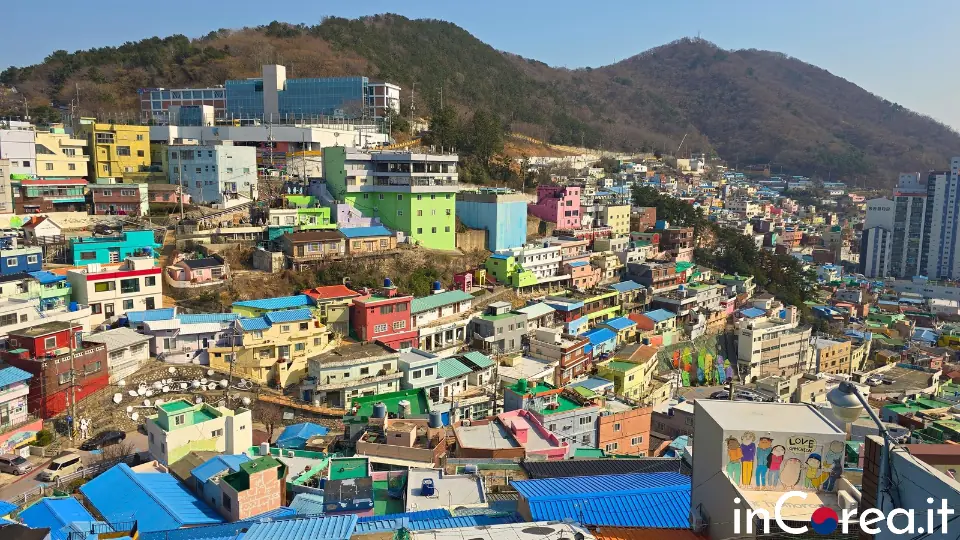
Gamcheon Culture Village is Busan's famous hillside neighborhood, where pastel-colored houses cascade down to the sea along narrow alleys, staircases, murals, and art installations. It's one of the most photographed spots in the city and a must-see on any Busan itinerary. But it's not a theme park: Gamcheon is a living neighborhood where people still call home, so visit with respect.
In this guide, you'll find how to get there, opening hours, the map, how much time you need, the best photo spots, and how to avoid the crowds. We'll also introduce Huinnyeoul Culture Village, a seaside village that most itineraries skip, and one of my personal favorites. Gamcheon is part of our Busan travel guide, where you'll find itineraries and tips for the whole city.
The origins of Gamcheon date back to the 1950s, during the Korean War. Busan became a refuge for people fleeing the front lines, and many settled on the hills of Gamcheon, where a community tied to the Taegukdo religion also took root. Homes were built on the slope one above the other, which is why the neighborhood has its signature terraced look today.
For decades, Gamcheon was a poor, forgotten neighborhood. Change came with the urban regeneration projects of the early 2000s, boosted by a 2009 public art program: artists and residents painted the building facades, turned vacant homes into exhibition spaces, and filled the alleys with sculptures and installations. Once a neglected district, it has become one of Busan’s cultural landmarks, nicknamed the “Machu Picchu of Busan.”
A detail that helps to visit it better: the colors and the works are a way to tell this story, but the houses are still inhabited. You will see this in the rules of conduct later on.
Gamcheon is a residential neighborhood with very few hotels, so it's not the best area to stay in Busan. The most convenient base nearby is Nampo: Toseong Station is just two metro stops away, a taxi to the village costs only a few thousand won, and you'll be close to Jagalchi Market, Gukje Market and Busan Diamond Tower. To choose the best area and see our recommended hotels, read our guide on where to stay in Busan. If you'd rather go straight to booking, browse these hotels in Nampo.
Busan is a huge city and its most beautiful places are far apart from each other. If you only have one or two days to spend, we strongly recommend taking a tour: alone, you risk seeing very little. The guided tours offered here combine the main sights in a single trip, such as Haedong Yonggungsa, the Blueline Park, Huinnyeoul and Gamcheon, with transportation and entrance fees included.
The village seems like a maze, but the main points are few and easy to recognize. These are the ones that really deserve it:
At the information center you will find a map at about 2,000 KRW with three routes to follow. If you complete the longest route and return to the information center, you will usually receive two free postcards.
| Route | Duration | Stages | For whom |
|---|---|---|---|
| A | about 40 minutes | 10 | Those who have little time |
| B | about 1 hour and 20 minutes | 20 | Complete visit without haste |
| C (route with stamps) | about 2 hours | 22 | Anyone who wants to see everything and collect the postcards |
The duration and stages are indicative: they may change if the village renovates the works.
In the village there are several local businesses run by the residents, and in some cases the proceeds go towards community projects. I recommend a few of them:
The houses are inhabited. Therefore, it is worth remembering a few simple rules:
The simplest way is the metro plus a neighborhood bus. There is no station under the village, so a bus ride is inevitable (or a taxi).
The buses are small and the road is steep, so you often have to walk. To pay, you need a transport card, as we explain in the guide on T-money card. The line numbers may change: always check on Naver Maps.
From Haeundae there is no direct connection: the most convenient solution is line 2 to Seomyeon and then line 1 to Toseong, or a taxi (about 40 minutes). From the center of Nampo and from Jagalchi, however, the taxi takes about ten minutes. If you take a taxi, show the name in Korean, Gammachan Cultural Village, Or use Uber which is more convenient.
If your itinerary includes the sunset time, the best combination is Gamcheon in the morning and then the Busan Diamond Tower in the evening: from the Toseong area to Nampo there are only a few stops on the same line 1.
If you have some extra time, combine it with Gamcheon Huinnyeoul Culture Village (White Stream Cultural Village), a village on the cliff of Yeongdo Island, with white alleys, murals, and a walk on the sea. It is one of the most beautiful things to do in Busan, and many itineraries don’t even mention it. Its cafés overlooking the sea are adorable; we’ll dedicate a separate guide to it; for now, just know that admission is free, that it’s about a 20-minute bus ride from Nampo, and that it takes less than 2 hours to visit. I recommend including it in the itinerary right before or after Gamcheon.
Personal tip: the first time I visited Gamcheon Culture Village, I went to Huinnyeoul first and then Gamcheon, and I took taxis to avoid switching buses and make the most of my time. If you're traveling with other people, taxis in Busan are really cheap compared to the time you save over public transportation. If you're short on time, I'd recommend using Uber and taxis as much as possible.
 Italiano Italiano Italiano
  English Italiano Italiano Italiano English