
If you are planning a trip to South Korea, Gyeongju is one of the destinations I highly recommend adding to your itinerary. The ancient capital of the Silla Kingdom is home to some of Korea’s most important historic sites and is often described as an open-air museum: from ancient burial mounds and temples to palaces, bridges, and treasures from the Silla period, Korean history is virtually everywhere you look.
Gyeongju is very different from Seoul and Busan, which is why I recommend staying for at least one night. With one full day, you can see the main attractions, but staying for two days gives you more time to visit Bulguksa Temple and Seokguram Grotto outside the city, as well as experience Gyeongju after sunset, when some of its most beautiful landmarks are illuminated.
In this guide, I’ll show you what to see and do in Gyeongju, where to stay, how to get there from Seoul and Busan, and how to plan a one- or two-day itinerary without wasting time on unnecessary travel. But let’s start with the most useful advice: get lost in its quiet streets and alleyways, because they’ll leave you with memories you’ll treasure.
When visiting Gyeongju, choosing the right area to stay is important because the attractions are spread across different parts of the city, although the main sights in the city center are all within walking distance. I recommend staying in the city center, especially if you want to be able to walk to Daereungwon, Cheomseongdae, Hwangnidan-gil, Gyochon Village, and Woljeonggyo Bridge. This also makes it easy to go out in the evening without having to rely on buses or taxis.
Hanok stays are very popular in Gyeongju and offer the opportunity to stay in traditional Korean houses, an experience I highly recommend. If you’re looking to save some money, I’ll also include a couple of excellent budget-friendly hotels. As you’ll see from my list of recommended accommodations below, the wide variety of hanok stays available means there are options for virtually every budget.
Another option, especially if you’re looking for a higher-end property and either have a rental car or don’t mind using taxis, is the Bomun Tourist Complex. This quieter area sits along the shores of Bomun Lake and is home to numerous hotels and resorts, including some of my recommendations below. Staying here offers a different experience, with a more relaxing setting surrounded by greenery just a few kilometers from the city. However, you’ll be farther from the main attractions in the city center.
Accommodation and hanok stays in central Gyeongju:
Hotels on Bomun Lake:
From Seoul, you can reach Gyeongju by KTX high-speed train in about two hours, arriving at Singyeongju Station. KTX trains connect Seoul with the Gyeongju area along the Gyeongbu Line, one of South Korea’s main railway lines.
Singyeongju Station is not located in the city center, so once you arrive, you’ll need to continue by bus or taxi.
Alternatively, you can take a bus from Seoul Express Bus Terminal, which is connected to Gyeongju Express Bus Terminal.
Busan is much closer to Gyeongju, which is why I find it particularly convenient to visit Gyeongju before or after your stay in Busan.
The best option is still the train: thanks to the KTX high-speed service, the journey from Busan to Gyeongju takes just 30 minutes. Alternatively, you can take a bus from Busan Central Bus Terminal, but the journey takes about twice as long, at around one hour.
If your itinerary already includes Busan and Seoul, Gyeongju is the perfect stop between the two, without having to make any detours. However, if you don’t have time to spend a night in Gyeongju, I strongly recommend booking a full-day trip to Gyeongju from Busan. This is a great way to visit the attractions outside the city center that you might otherwise miss. I recommend these comprehensive and affordable guided tours. Through the Trazy and GetYourGuide links below, you’ll find, in order:
If none of these three options meet your needs, you can use the same Trazy and GetYourGuide links to browse other types of guided tours and experiences in Gyeongju.
What can you see in Gyeongju in one day? The best part of Gyeongju to explore on foot is the city center. This is where some of the city’s most important attractions are located, and you can enjoy a pleasant walk among royal tombs, archaeological sites, hanok houses, and monuments from the Silla period. I always recommend wandering through Gyeongju’s quiet streets, because every alley, hanok, or cat you come across can become a wonderful memory.
The city center is fairly compact, and many attractions can be visited on foot one after another. For this reason, I recommend spending at least part of your day exploring this area rather than constantly traveling back and forth across the city. If you only have one day in Gyeongju, I strongly recommend making the most of your time by joining an organized tour.
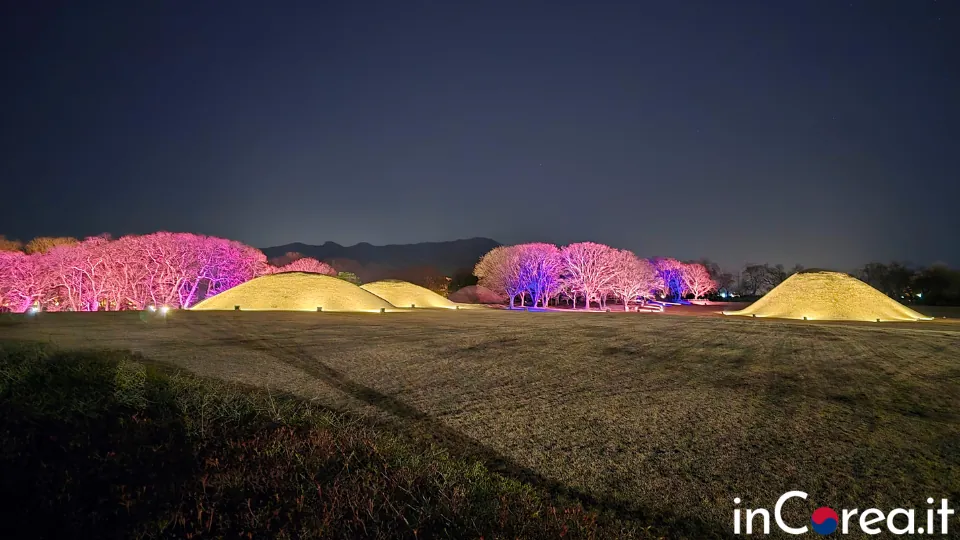
The Daereungwon Ancient Tomb Complex is probably the place that best represents Gyeongju. The large green mounds you see in the center of the city are not simply hills: they are ancient tombs belonging to kings and nobles of the Silla Kingdom. The complex contains around 20 burial mounds, creating a truly unique landscape in the heart of the city.
Among the most interesting tombs are Cheonmachong (admission is only KRW 3,000) and Geumgwanchong (free admission), both of which can also be visited from the inside. The exhibits allow you to see the structure of the tombs and some of the artifacts discovered during excavations, along with engaging multimedia installations.
This is one of the first stops I would include in a Gyeongju itinerary because it immediately gives you a sense of how deeply the history of the Silla Kingdom is still woven into the city’s landscape.
A few minutes’ walk from Daereungwon, you’ll find Cheomseongdae, one of Gyeongju’s most iconic landmarks and one of the city’s most famous historic structures.
This distinctive stone tower dates back to the Silla period and is generally considered one of the oldest astronomical observatories in East Asia. The visit is fairly short, but its location makes it a convenient stop before continuing on foot to the other nearby attractions.
In spring and fall, the surrounding area is particularly pleasant to explore and is also a popular spot for taking photos. If you’re staying in Gyeongju for several days, the entire Daereungwon area, with its trees, as well as Cheomseongdae itself, is illuminated at night, as you can see in my photos. During cherry blossom season, the scenery is especially beautiful.
If you want to see the more modern and lively side of Gyeongju, take a walk along Hwangnidan-gil.
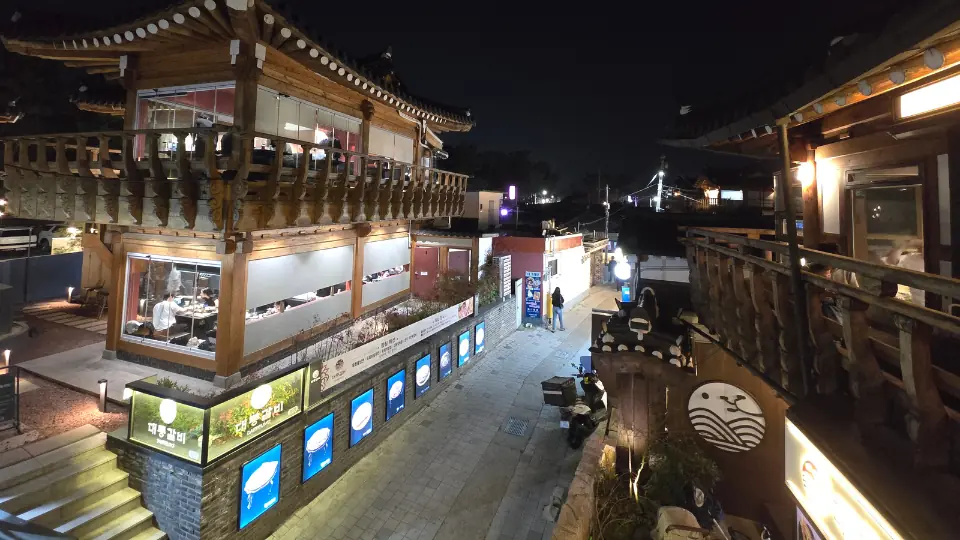
This popular street is known for its traditional hanok houses that have been transformed into cafés, restaurants, shops, and small local businesses. It’s where Gyeongju’s history meets contemporary Korean culture, with a very different atmosphere from the city’s archaeological sites.
It’s a great place to stop for lunch or dinner, grab a coffee (I had the best coffee of my life here), or simply take a break while exploring the city.
You can then continue to Gyochon Hanok Village, a traditional neighborhood known for its hanok houses, small shops, and places connected to the area’s local history.
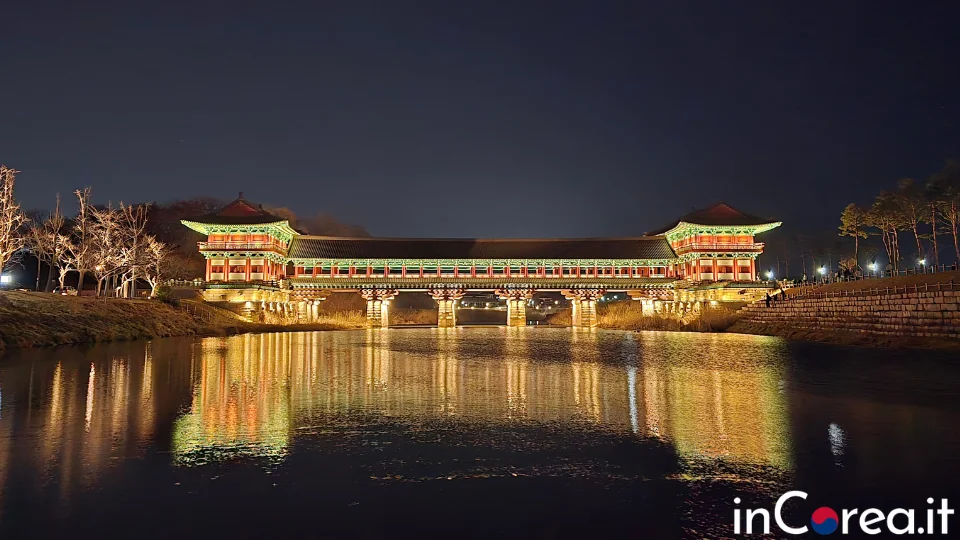
From here, you can walk to Woljeonggyo Bridge, which is also the featured image of this page and one of the most photographed landmarks in Gyeongju. The bridge was reconstructed based on the design of the original Silla-era structure and is particularly beautiful after sunset, when it is illuminated and the atmosphere changes completely. If you visit during the day, I highly recommend coming back in the evening as well—you won’t regret it. At this point, I recommend having dinner before heading to the final stop of the day.
The final stop of the day is Donggung Palace and Wolji Pond, one of the most beautiful places in all of Gyeongju. If you still have some energy left, it’s about a 20-minute walk from the city center; otherwise, you can easily get there by taxi or bus.
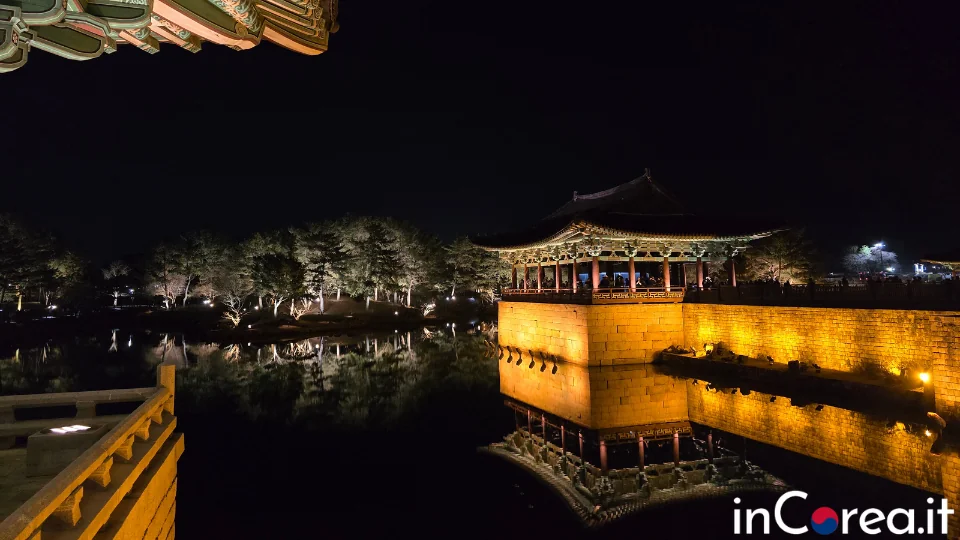
The palace was part of the Silla royal complex, while Wolji Pond was formerly known as Anapji. The pavilions reflected in the water have become one of the most iconic views in Gyeongju. Admission is only KRW 3,000.
The best time to visit is around sunset. This way, you can see Donggung Palace and Wolji Pond in daylight, watch the sunset, and then stay until the evening lights come on. Once illuminated, the palace and pond become even more spectacular.
If you can’t make it there by sunset, visiting in the evening is perfectly fine. In fact, Wolji Pond looks its best after sunset: the illuminated pavilions and their reflections on the water create one of the most beautiful scenes in Gyeongju.
If you’ve followed the route in the order I recommended, this is the perfect way to end your first day. However, if you’re only staying in Gyeongju for one day, I recommend using your last bit of energy to go back and see the spectacular Woljeonggyo Bridge at night.
If you can spend two days in Gyeongju, this is the option I recommend most.
To recap: on the first day, dedicate your time entirely to the city center by following the route outlined in the previous section: Daereungwon → Cheomseongdae → Hwangnidan-gil → Gyochon Hanok Village → Woljeonggyo Bridge → Donggung Palace & Wolji Pond. This gives you plenty of time to stop at cafés, enjoy a relaxed lunch, and see the bridge both during the day and after dark.
On the second day, spend the morning visiting Bulguksa and Seokguram. In the afternoon, choose based on your interests between the Gyeongju National Museum, Bomun Lake, or another walk through Gyeongju’s hanok neighborhoods. With two days, you won’t have to rush from one attraction to another, and you can also adjust your plans according to the weather and season.
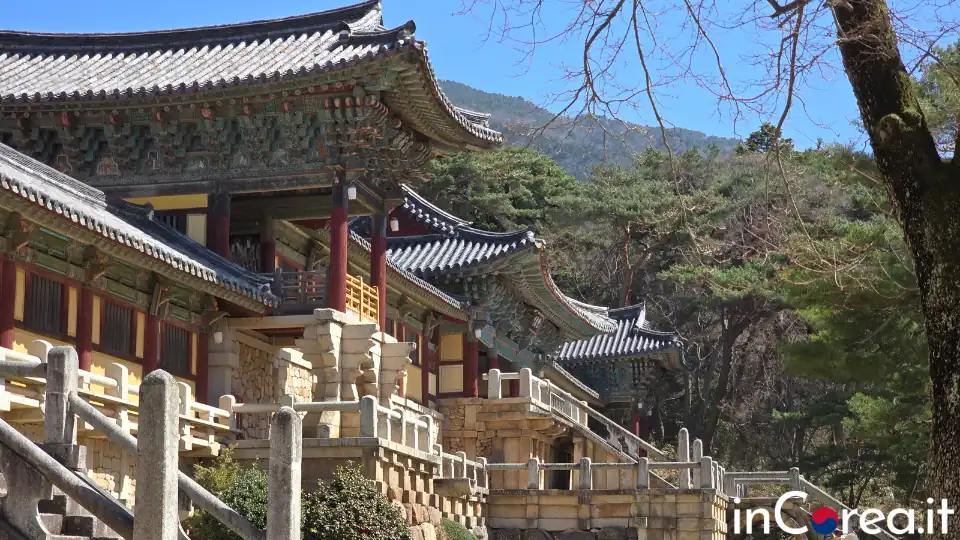
Spend the morning at Bulguksa Temple, one of the most important Buddhist temples in South Korea.
The complex, along with Seokguram Grotto, has been a UNESCO World Heritage Site since 1995 and preserves important examples of Buddhist art and architecture from the Silla period.
Take your time to explore the courtyards, pagodas, stone stairways, and various pavilions. Compared with the attractions in the city center, Bulguksa is best experienced at a slower pace and shouldn’t be treated as just another quick photo stop.
From Bulguksa, you can continue to the underground temple of Seokguram, an artificial grotto built during the Silla period that houses a famous statue of the Buddha.
Seokguram is also part of the same UNESCO World Heritage Site and is one of the most important examples of Buddhist art from the ancient Silla Kingdom.
Both attractions are located on Mount Tohamsan and should therefore be considered part of the same excursion. You can reach them by local bus or, especially if you’re traveling as a couple or group, take a taxi to save time on transportation.
If you still have time in the afternoon, you can visit the Gyeongju National Museum, which is particularly interesting if you want to learn more about the history of the Silla Kingdom. The museum houses numerous artifacts unearthed during excavations in and around Gyeongju and provides a deeper understanding of the history you encountered while visiting the burial mounds, temples, and ancient palaces.
However, I wouldn’t consider it essential if you only have one day in Gyeongju. I would prefer to spend that time visiting the city’s main attractions instead. Admission to the Gyeongju National Museum is free.
If you’re looking for alternatives for what to see in Gyeongju, another option for the afternoon is to visit the Bomun Tourist Complex and Bomun Lake. This area is very different from central Gyeongju: it is home to modern hotels and resorts, restaurants, cafés, and plenty of greenery surrounding the lake. The area is also popular with Koreans for its hotels and resorts, and you can discover a carefully selected list in the previous section.
It is particularly enjoyable in spring when the cherry blossoms are in bloom, but it can also be a great choice simply to slow down and relax after a morning spent exploring temples and historic sites.
If you’ve chosen a hotel in the Bomun area, you can of course spend the afternoon exploring the surrounding area without having to return to the city center. This is not an essential stop either, and I recommend it only if you’re interested in taking a stroll around the lake and want to see a different side of Gyeongju.
Here are answers to some of the most frequently asked questions about Gyeongju.
Yes. Gyeongju is one of the best destinations in South Korea for exploring the history and culture of the Silla Kingdom. It is very different from Seoul and Busan, and adding it to your itinerary as a stop between the two cities is a great way to slow down, take a break, and experience a completely different side of South Korea.
If it’s your first time in Gyeongju, I recommend staying in the city center, where you can easily walk to the main attractions and go out in the evening, perhaps staying in a traditional hanok. Alternatively, the Bomun Lake area is ideal if you prefer more modern and upscale hotels and resorts, but you’ll need to rely on public transportation or taxis to get around. Discover the best places to stay. Scoprite quali sono gli alloggi migliori.
I recommend staying for at least 1 night, while 2 nights are ideal for exploring the main attractions at a relaxed pace and enjoying some downtime after visiting Seoul or Busan. If you can’t stay in Gyeongju for at least one night, I strongly recommend booking a guided tour so you can make the most of your time and see as much as possible.
One full day is enough to visit only the main attractions in the city center, but if you want to see more in a single day, I strongly recommend joining a full-day tour from Busan. With 2–3 days, you can also visit Bulguksa, Seokguram, and the other attractions outside the city center without having to rush.
In the city center, you can easily get around on foot. To reach Bulguksa and Seokguram, it’s best to use public buses or taxis, while Donggung Palace and Wolji Pond can be reached on foot from the city center in about 20 minutes, or by bus if you’re tired. To get to Bomun Lake, you can take a bus, taxi, or drive. Taxis in South Korea are relatively inexpensive and are a convenient option when you want to save time getting around.
 Italiano Italiano Italiano
  English Italiano Italiano Italiano English